The Vega upgrade: expanded staking and tokenomics
Vana is a network for moving personal data. A person decides which app or AI may read which of their data and for how long; the network moves it, records the permission, and lets them revoke it. Node operators run the infrastructure that does that work. VANA is the token the network runs on.
Today three things go live as part of the Vega upgrade: expanded staking, the paper VANA: The Asset Behind an Open Data Economy, and a public dashboard. All can be found at token.vana.org.
What shipped
A fee on every read. When an application reads a piece of a person's data under a permission they granted, it pays the network one cent per scope-read. Granting the permission is free; paying starts when the data is used. The person never pays; the app can sponsor it. Every move of one person's data is a paid read, alongside the fees the network earns when pooled datasets are accessed.
Reads are the metered event, and they repeat. One application reading one scope once a day is 365 priced reads in a year, from a single act of contribution. The fee base scales with how much the data is used, not with how many users join.
Staking into the infrastructure that moves the data. A holder stakes VANA into one of the staking pools that secure the network. Stakers receive a 60% share of the fees applications pay to read data, converted to VANA. It grows as usage grows. Three staking pools are open at stake.vana.org, each with a 5% operator commission. Rewards are paid from network fees and accrue to your position, and you can claim them as they accrue.
How every fee is split. Each fee is divided by protocol rule: 60% to stakers through the staking pools, 20% to buyback and burn, 20% to ecosystem growth. The staker and burn shares are used to buy VANA on the open market; the burn share is then removed from supply, and every buyback and burn is published with its transaction hash. The remaining 20% funds builders on the network. The split is set by protocol parameter, not a discretionary decision each cycle; it moves with reads and with nothing else. The detail is in VANA: The Asset Behind an Open Data Economy.
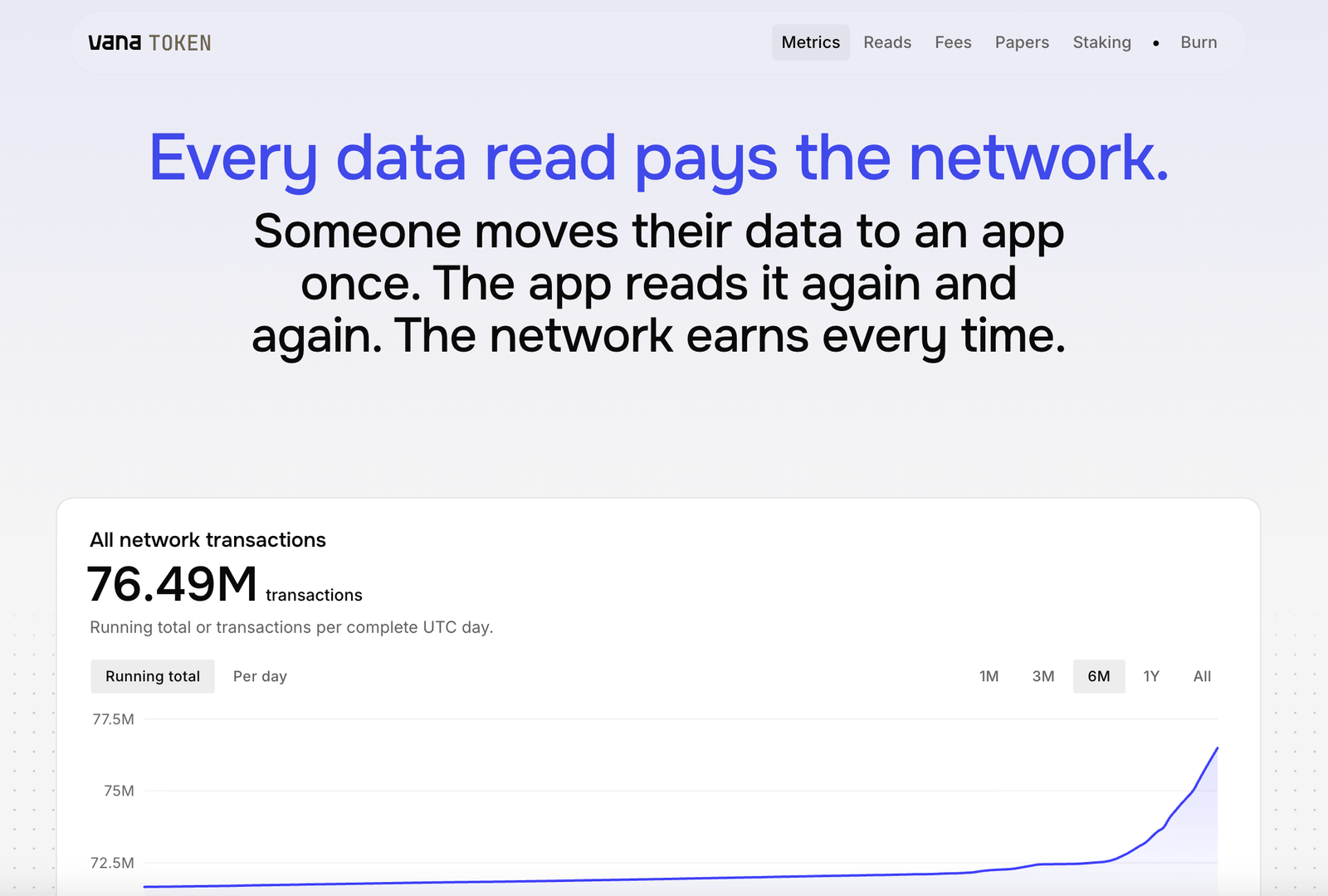
A dashboard. token.vana.org shows reads, fee income, burn and supply, with the on-chain record behind each figure.
Why it exists
Moving personal data at the speed AI requires is an infrastructure job. Every read means checking the permission, writing the record and delivering the data, in about 50 milliseconds, and the node operators doing it handle real people's data under real permissions. The network has to be secured and the node operators have to be paid. Staking secures it; the fee split pays for it.
As usage grows, fees fund the node operators, reduce the supply of VANA and pay the builders, without relying on new issuance.
Why usage grows
AI models are converging. On a recently published leaderboard aggregating 27 benchmarks, the top three models sit less than half a point apart. Users behave accordingly: a July survey of 5,067 US adults found the average person now uses three general AI assistants, up from about two a year earlier.
Three assistants, none of which knows what the other two know. Everything a person has told one of them stays there. What an AI knows about you is the one thing that does not transfer when you switch. Every assistant that reads your context, every day, is a read on the network.
Regulation closes the obvious shortcut. Under the data portability rules now in force from Korea to Europe, a person's data moves when they ask and only when they ask; copying it once and retaining it is not permitted. Permissioned movement is the only compliant route, and the Vega upgrade runs it at the speed AI needs.
Vana wrote the standard for how personal data moves, and it is now a global community standard hosted at the Linux Foundation, so a regulator can point to it and a company can build against it. The Vana CLI puts it in a developer's terminal today, and governments are scoping national implementations on the same rails. Every one of those reads, from a desktop agent or a national service, settles on the network and pays it.
What stays fixed
VANA is issued against a policy cap of 120,000,000 tokens, and the release schedule for locked tokens is unchanged. Burn scales with fee income. Beyond a level of activity the paper sets out, more VANA is burned each year than is created, and net supply contracts, with no vote and no manual step.
What to watch
One number: reads, and how fast it grows. Reads scale with usage, not with sign-ups. An AI assistant working for one person can read their data thousands of times a day, and each read is a fee.
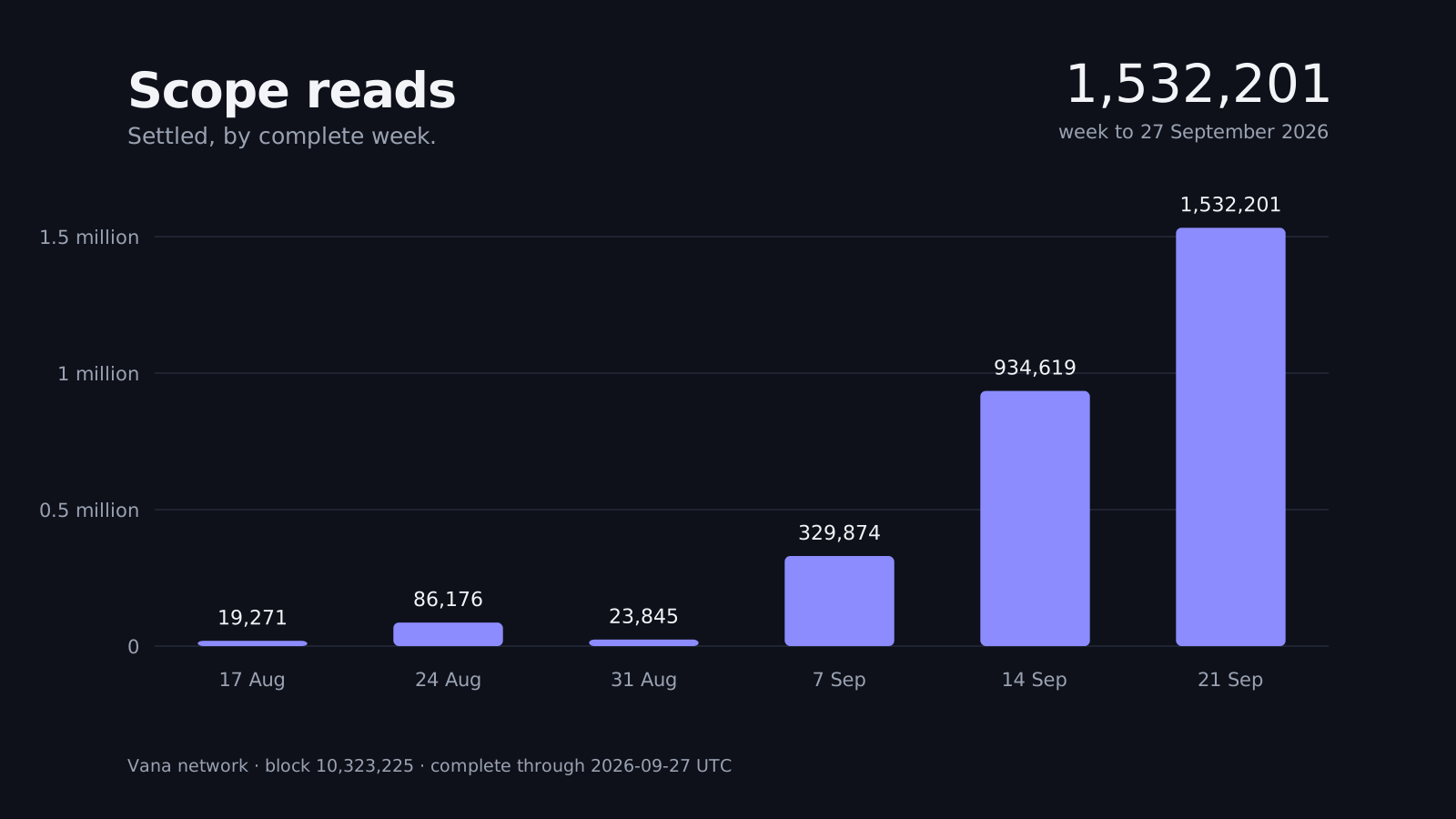
The chart above is that number. Applications on the network have produced 2,937,447 verified reads to date, as at 28 September 2026. The burn simulator at token.vana.org lets you set read volume and price and see where burn overtakes issuance. 738,100 VANA is staked on the network today.
Metering on personal data reads is live, and every figure above is public at token.vana.org, where each buyback and burn can be verified on chain.
If you already stake VANA, move your position into one of the three pools at stake.vana.org by midnight UTC on 31 October 2026. It is one transaction and your VANA stays inside the protocol. Principal can be withdrawn at any time, with no deadline. After 31 October, a position that has not moved no longer earns rewards.
The paper, VANA: The Asset Behind an Open Data Economy, and the technical addendum, The Vega Upgrade: Data Portability and Transformations, are both at token.vana.org.